What is AEO
Answer Engine Optimization: Definition and Comprehensive Guide
What is AEO
AEO (Answer Engine Optimization) is the practice of optimizing brand, product, and information source visibility within AI-powered answer engines such as ChatGPT, Perplexity, Claude, and Gemini -- ensuring your brand is mentioned and cited in AI-generated answers.
AEO is also known as GEO (Generative Engine Optimization), GSO (Generative Search Optimization), and LLMO (Large Language Model Optimization). These terms refer to the same concept; the industry has not yet settled on a single term.
This site uses "AEO." LLMO is the label that dominates the Japanese-speaking market; see What is LLMO for how the terms relate.
Why AEO matters now
As AI search spreads, a growing share of queries is answered without a click. Ranking well no longer guarantees traffic, so SEO on its own is not enough to keep a path open to the user.
- AI Overviews cut click-through rates on top-ranking pages by 34.5-58% (Ahrefs)
- Zero-click searches rose from 56% in 2024 to roughly 60% in 2025 (SparkToro / Datos)
- ChatGPT handles more than 2.5 billion prompts per day (TechCrunch)
- Search engine volume is forecast to drop 25% by 2026 (Gartner)
SEO vs. AEO
SEO is the art of appearing on the list, while AEO is the art of being chosen as the answer.
SEO aims for a high position in search result listings. AEO aims for your brand to be included in AI-generated answer text. In SEO, results for a given keyword are deterministic, making performance metrics straightforward. In AEO, both the AI output and user queries vary widely, making it difficult to define performance with simple rankings.
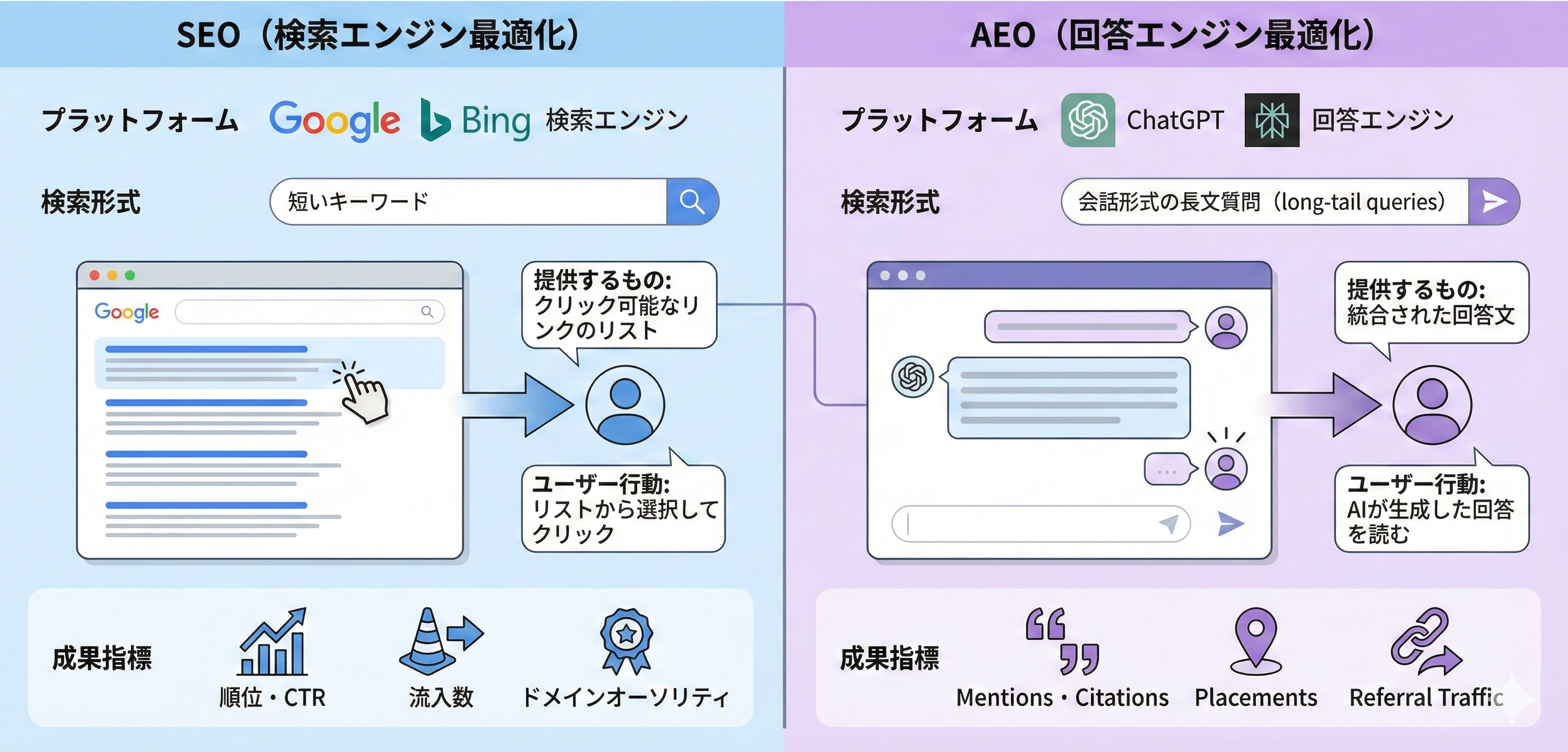
- Aims to appear in search result "lists"
- Clear rankings (1st, 2nd...)
- Results are deterministic for a given keyword
- Performance metrics are straightforward
- Aims to be chosen in AI "answers"
- Output varies significantly
- Same question can yield different answers
- Performance metrics are hard to define
| Dimension | SEO | AEO |
|---|---|---|
| Goal | Rank high in search results | Be cited and mentioned in AI answers |
| Main platforms | Google and Bing result pages | ChatGPT, Gemini, Perplexity, AI Overviews |
| Crawlers | Googlebot | GPTBot, ClaudeBot, PerplexityBot |
| Measurement | Search Console | AEO monitoring tools |
| Key metrics | Rank, clicks, CTR | Mentions, Citations, Response Share |
AEO Metrics
The following metrics are currently observable in AEO:
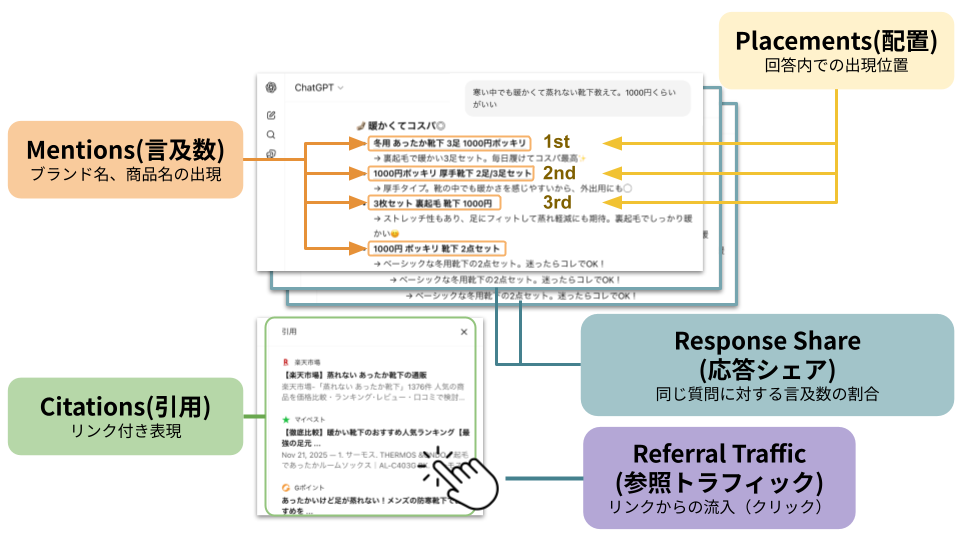
The frequency at which your brand is mentioned in AI responses. If a brand is referenced once in a single AI response, we say there was "1 mention for that query." Unlike Citations, Mentions are counted whenever the brand appears in the response text, regardless of whether a link is included.
The frequency at which your brand is cited as a source in AI responses. A Citation is counted only when a URL link to your brand is included as a reference. If no links are included in the response, Citations are automatically 0.
The position within the AI response where your brand is mentioned (1st, 3rd, etc.). Since AI responses are rarely structured in a standard format, placement is typically determined by ranking the order in which mentioned brands appear in the text.
Actual click-through traffic from AI responses. Only counted when a link is cited in the response. By calculating [Referral Traffic] / [AI Responses], you can determine the referral traffic percentage.
The percentage of times your brand is mentioned across multiple trials of the same question. If you ask the same question 100 times and your brand is mentioned in all 100 responses, you have a 100% Response Share. Values vary by AI engine and industry.
How AI Processes Content
To understand AEO, you need to understand how AI processes web information when generating answers.
This section describes the process from when an AI engine receives a user's question to when it generates a response, in chronological order.
*) The system described here is one example. Some AIs do not use all of these techniques, and others may process web content differently.
1. Query Understanding and Expansion
User questions (also called queries) are not sent directly to search engines. The AI performs the following processing:
Named Entity Recognition (NER)
Identifies and classifies proper nouns such as person names, organization names, and product names within the query to improve search precision. The identified entities determine the sub-queries generated in subsequent steps.
Intent Classification
Classifies the user's question intent to determine how the AI should generate its response. Traditional SEO used Navigational / Informational / Transactional classifications, but AI query classification encompasses these while performing more granular, proprietary categorization.
Query Rewriting
Converts the user's natural language question into a format that search engines can process more effectively.
Query Expansion (Query Fan-Out)
Splits a single question into multiple sub-queries for parallel search. Beyond main query rewriting, sub-queries help retrieve "common facts" documented across many sources.
2. Hybrid Search
The AI searches pre-built indexes for relevant chunks. For web search scenarios, an Agent performs Google searches on behalf of the system using the processed queries.
Sparse Retrieval (Keyword Search)
Uses the same search algorithms as standard Google search, matching keywords between the query and website content. Scores relevance using TF (Term Frequency) and IDF (Inverse Document Frequency). Particularly strong for searching proper nouns like brand and product names.
Dense Retrieval (Semantic Search)
A search method based on semantic similarity, primarily used in RAG systems. Converts queries and documents into high-dimensional vectors and measures cosine similarity to quantify "semantic closeness." Reflects context, favoring content that is semantically close to the user's search intent.
The weighted combination of these two methods is called Hybrid Search. When a query contains brand names or specific product keywords, sparse retrieval is weighted more heavily. For abstract queries without specific keywords, dense retrieval takes precedence. The weighting adjusts automatically.
3. Re-Ranking
The AI re-sorts retrieved websites and narrows them down to 10-20 results.
Cross-Encoder
Rapidly scans candidate results, evaluating relevance based not just on keywords but on logical coherence and information completeness.
Top-K Selection
Selects the top K chunks from re-ranked results for input into the LLM prompt. Selection considers not only re-ranking scores but also information diversity and domain authority.
4. Context Extraction and Information Extraction
Removes noise from retrieved web information to finalize the data used for answer generation.
Entity Recognition
Analyzes page content to evaluate credibility by extracting brand names, product names, etc. Calculates Entity Salience -- the importance of specific entities within the document.
Snippet Extraction
Summarizes and extracts data from selected web content to fit within the LLM's context window.
Position Bias-Aware Placement
LLMs tend to process information within prompts as follows, so the most relevant information is placed at the beginning or end of the data:
- First information (Primacy Bias): Strongly recognized
- Middle information: Tends to be overlooked
- Last information (Recency Bias): Strongly recognized again
5. Answer Generation and Guardrails
The AI generates its answer through several processes before displaying the final response to the user.
Jailbreak Detection
Before or after generation, checks whether the user's question is malicious or whether the response violates AI policies.
LLM Answer Generation
The LLM generates a response based on the organized information.
Grounding
Verifies that the generated answer is logically consistent with source information.
Citation / Attribution
Attaches source URLs and citations to information that passes the verification checks.
6. Re-Search Loop (Agent-Based Only)
Standard AI search systems complete processing in 5 steps. However, agent-based models like Google Gemini's Deep Research and ChatGPT's Deep Research may perform additional searches.
Agent-Specific Re-Search
AI agents that can decompose tasks, take corrective actions, and remember past search behaviors may autonomously modify search terms, re-search, or examine additional pages based on their assessment of whether expected information was found.
Technical requirements for AEO
Given how that pipeline works, the technical requirements for being citable come down to the following.
- Server-side rendering: AI crawlers do not execute JavaScript, so a SPA without SSR is invisible to them
- AI bots allowed in robots.txt: GPTBot, ClaudeBot, and PerplexityBot need an explicit Allow
- Nested structured data: express the Organization, WebPage, and Article relationships so an LLM can read them as entity relations
- Low time to first byte: a page that does not respond during a crawl is simply not fetched
- Question-shaped headings: phrase H2/H3 as questions and follow each with a 40-60 word direct answer
- llms.txt: tell AI systems where your content lives and what it covers
Current State and Challenges of AEO
AEO is a rapidly evolving field with the following challenges:
While SEO has numerous measurement tools like Google Search Console, Ahrefs, and Semrush, dedicated AEO measurement tools are virtually nonexistent.
The internal algorithms of widely-used AIs (ChatGPT, Perplexity, Gemini, etc.) are not fully disclosed, requiring inference-based observation in some areas.
In SEO, you can see which keywords users searched for. In AEO, there is no visibility into what questions users asked the AI.
While SEO could focus primarily on Google optimization, AEO requires adaptation across multiple platforms including ChatGPT, Gemini, Claude, and Perplexity.
Unlike SEO where results are deterministic for a given keyword, AEO outputs are non-deterministic even for identical inputs, making performance assessment extremely difficult.
AEO Monitoring Tools
Sighted monitors brand visibility across major AI search engines including ChatGPT, Perplexity, and Gemini on a daily basis, measuring and visualizing metrics like Mentions, Citations, Placements, and Response Share.
- Multi-platform support (ChatGPT, Gemini, Perplexity, etc.)
- Automated Mentions / Citations / Placements measurement
- Response Share monitoring
- Competitor brand comparison analysis
- Daily trend analysis for measuring improvement effectiveness